

Photo: NASA
The three-quote rule: how to follow it without stalling the purchase
Your purchasing policy asks for three quotes. The purchase is due tomorrow. OrbitQuote requests quotes from several suppliers, follows up with whoever hasn't replied, lines the quotes up side by side and keeps the reasoning behind every decision. You follow the rule without losing the week.

Every company that goes through an audit knows the rule: a purchase above a certain amount needs three quotes. And every buyer knows what comes next. Find three suppliers who sell that item. Send the same request three times. Wait. Chase whoever went quiet. Open three quotes, each written its own way, and build the spreadsheet. Then explain to whoever approves why you bought from whom you bought. With ten items, that's an afternoon. With fifty items and a maintenance shutdown waiting, the third quote turns into a formality. Below: where the rule gets stuck and how OrbitQuote takes that work off your plate, with screens from the system.
Why the three-quote rule exists
Three quotes for the same request show that the price was tested on the market and that the choice didn't depend on one person alone. That's what an auditor looks for: who was asked, who replied, how much each one asked for and why the winner won.
Where public money is involved, the rule is often written down, and each country writes it its own way. Here's how four English-speaking countries handle it.
Which country do you buy from?
Pick your country and we'll show only the rule that applies there. Without a choice, you see all four.
United States
Federal grant rules (2 CFR 200.320) require price quotes from an adequate number of qualified sources on small purchases, and leave it to each organization to decide what that number is.
United Kingdom
Since February 2025, public purchasing follows the Procurement Act 2023, whose full procedures apply above the legal thresholds. Below them, the number of quotes comes from each public body's own contract procedure rules: Guildford Borough Council, for example, asks for at least three quotes between £5,000 and £25,000.
Canada
Federal contracting rules require bids to be solicited before a contract is entered into, with exceptions such as a pressing emergency, a single capable supplier or a low-value contract (Government Contracts Regulations, sections 5 and 6).
Australia
At federal level, the Commonwealth Procurement Rules make value for money the core rule. For departments and other non-corporate Commonwealth entities, purchases of $125,000 or more outside construction go to an open approach to market unless an exception applies, and since November 2025, purchases from $10,000 up to that threshold can only invite Australian businesses.
In private companies, the rule comes from the purchasing policy, the compliance program, the external auditor or whoever funds the project. The number varies from company to company.
The rule, followed, in one minute
- Finds the suppliers. The buying agent searches online, uses yours, or both. You say how many you want per batch.
- Requests and follows up for you, from your email or your WhatsApp, with the reply deadline and the number of attempts you set.
- Takes quotes the way they arrive. PDF, spreadsheet, photo or email becomes a flow with the items read. Nobody types.
- Puts the same item on the same row, even when it's written three different ways, with each supplier's terms.
- Flags what doesn't add up: an item with a single quote, a supplier below its minimum order, an item with no supplier.
- Keeps the trail: the authorization with date and time, every conversation, the original document and the step-by-step of each decision.
Why almost nobody follows it
It isn't a lack of will. It's a matter of time. Every quote has five steps, and each step repeats for every supplier:
- Find who sells it. Your usual supplier is in your contacts. The second and third aren't always.
- Request. The same email, with the same list, three times.
- Follow up. One replies the same day, another the following week, the third never does.
- Type. Each quote arrives in its own format, with the item written the supplier's way.
- Justify. Build the comparison and explain the choice to whoever approves.
When the deadline gets tight, the shortcut shows up: the order goes to the usual supplier and the other two quotes arrive later, just to complete the file. The rule is followed on paper, but the price wasn't tested. Pushing the buyer harder doesn't fix that. Taking those five steps off the buyer's hands does.
The agent requests and chases the quotes
You send the list: spreadsheet, PDF, photo or text. The buying agent splits the items into batches, so each group goes to the suppliers who sell it, and for each batch it uses your suppliers, finds new ones online, or both. For the search, you say how many qualified suppliers you want per batch, starting at five, and how far to look: same city, region, state or the whole country.
The request goes out under your name, from your email or your WhatsApp, with the items, the quantities, your payment terms and the reply deadline. Before sending, the system checks that the email exists and that the number is on WhatsApp. Whoever hasn't replied gets a new message, at the interval and number of attempts you set.
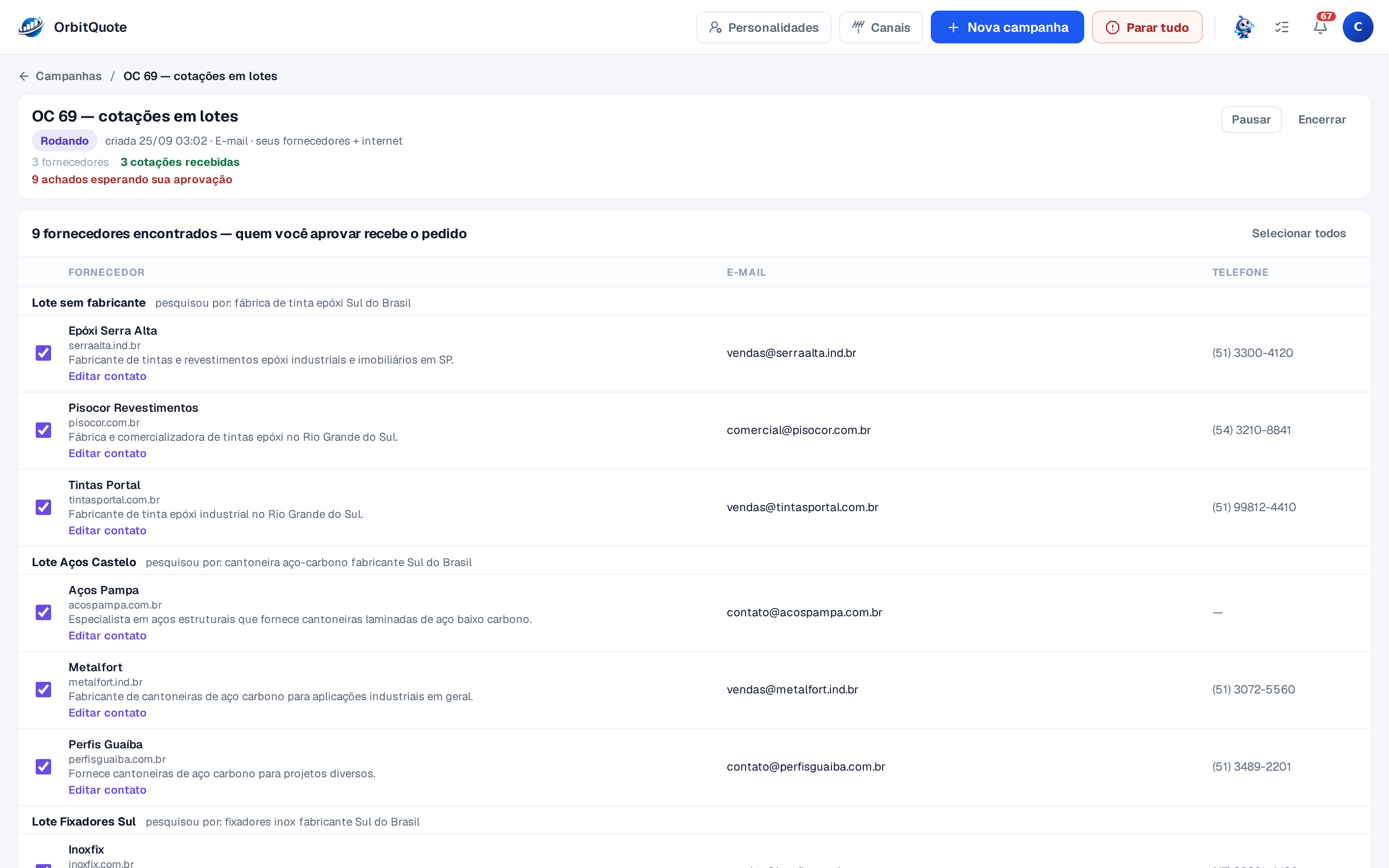
When the quote arrives, as an attachment, in the email body or in the WhatsApp chat, it becomes a flow with the items read, ready to compare. You don't need to open the email. The campaign step by step is in the article about the AI procurement agent.
Want your next request to come back with three quotes, without writing an email?
The buying agent is in early access. Create your account and request access on the agents screen. Quote reading and comparison are included in every plan.
Create an account and request accessThree quotes on the same row
Quotes arrive different. In the sample below, three PPE and maintenance suppliers quoted the same list. The nitrile glove came written three ways: one supplier spelled it out in full, another used an all-caps abbreviation with the box size, and the third called it a procedure glove. OrbitQuote recognizes it's the same item and puts the three prices on the same row of the quotation map. To build one by hand, see the price comparison sheet.
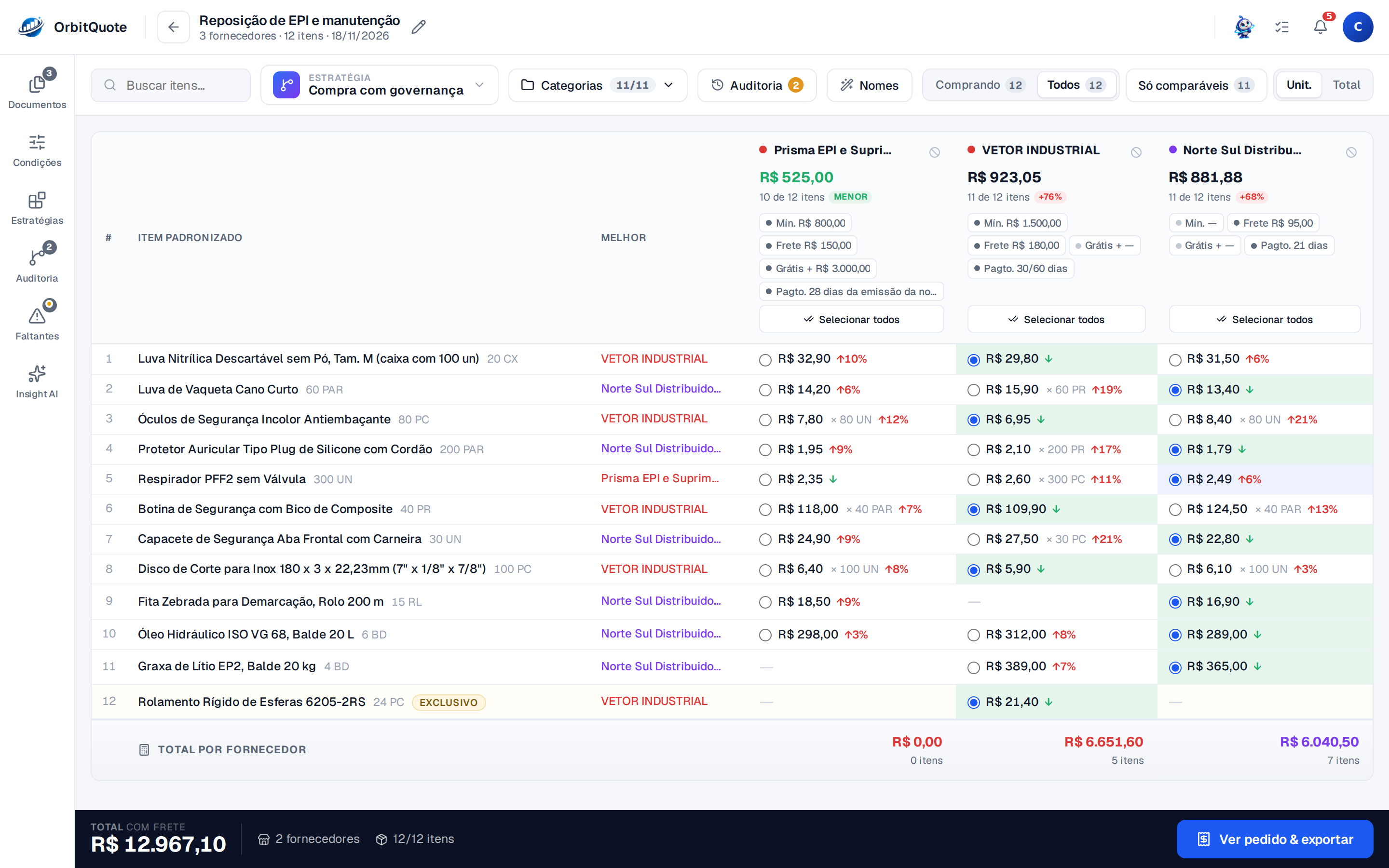
At the top of each column are the terms the supplier wrote: minimum order, freight, free freight above what amount and payment terms. The criterion picks who to buy each item from, and the total already includes freight. The system does the math, not the AI: the same map with the same criterion always gives the same result. The criteria are on the comparison page.
The audit trail explains every decision
The auditor always asks the same thing: why this supplier? In OrbitQuote, the answer is in the Audit trail, which shows, step by step, how the criterion decided: the price of each item, freight, the minimum order and the result.
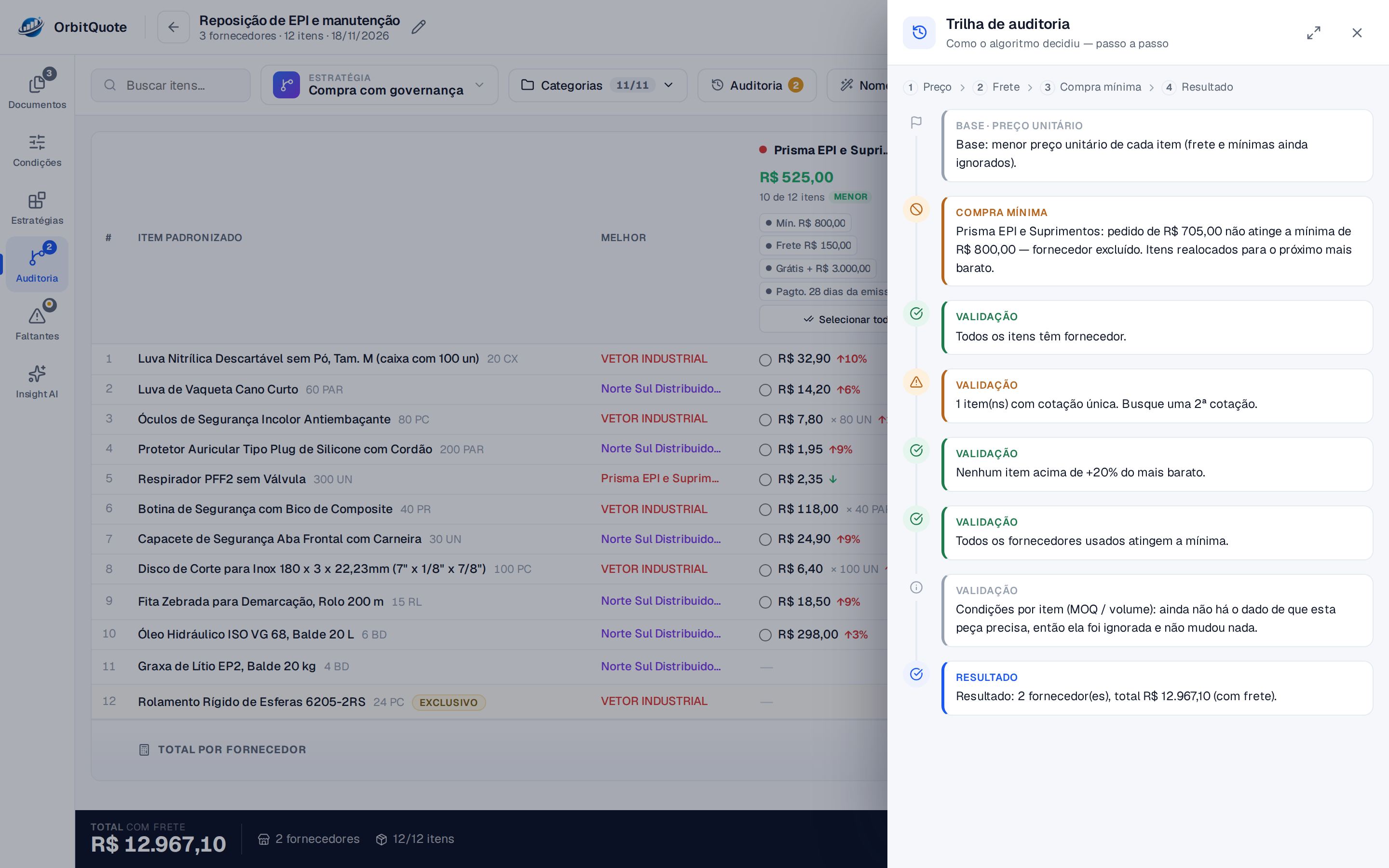
In the sample, Prisma had the lowest price on the respirator, but its order added up to R$ 705.00, below its R$ 800.00 minimum. The trail says so, with the numbers, and shows the items moved to the next cheapest supplier. It also warns that one item, the bearing, got a single quote: “Look for a 2nd quote.”
Those warnings come from the strategy's checks. The ready-made Purchase with governance strategy comes with them turned on: full coverage, items with a single quote, no item more than 20% above the cheapest, minimum order met and per-item conditions. In the strategy studio, you build your own and can add a budget cap that blocks when the total with freight goes over it.
The warning is for an item with a single quote. If your policy asks for three, the map itself shows how many came in: every empty cell is a quote that didn't arrive.
A quote missing for an item? The screen shows it
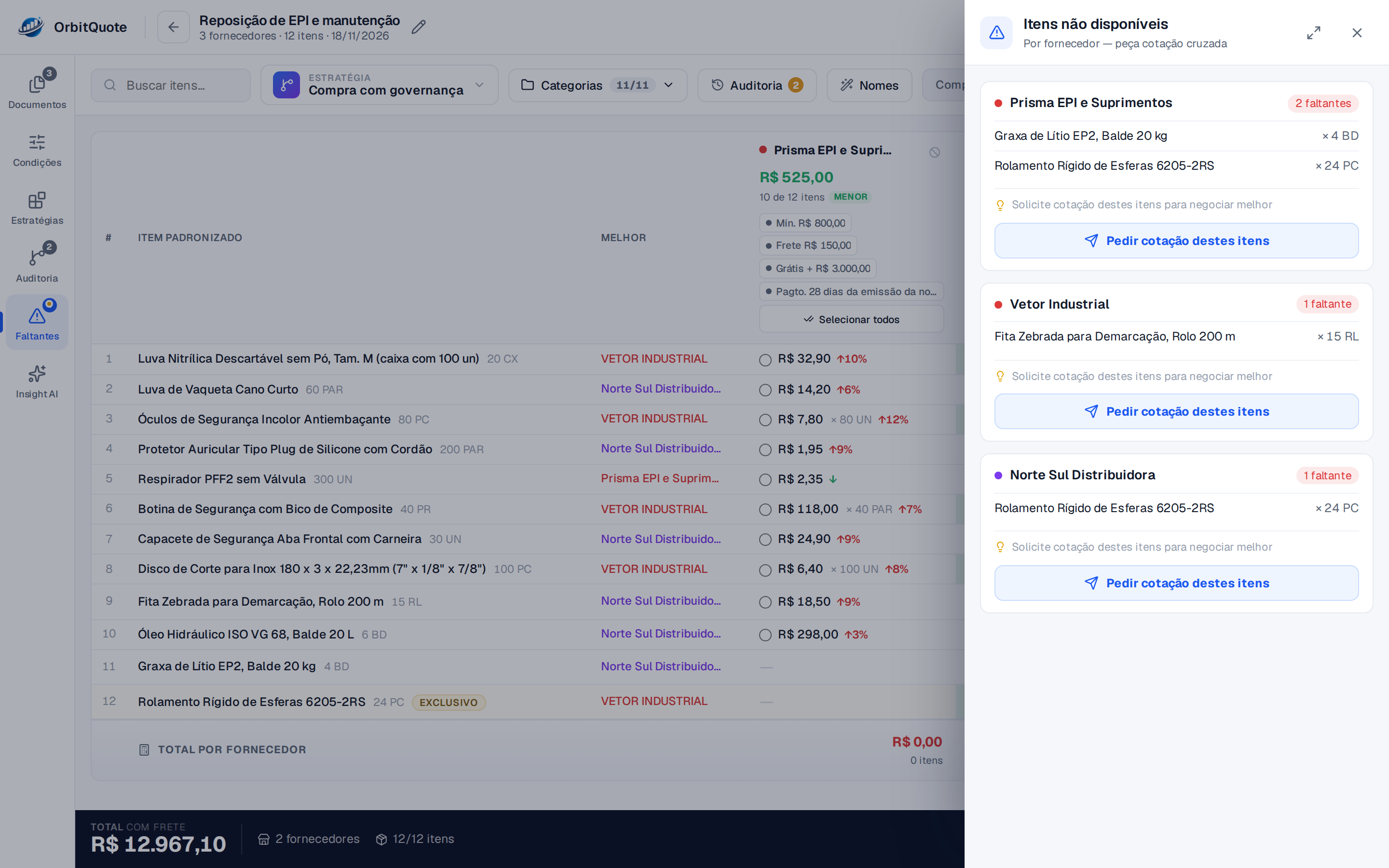
Not every supplier quotes everything. The Missing drawer lists, per supplier, the items it didn't quote. In the sample, two suppliers didn't quote the bearing, one didn't quote the grease and another didn't quote the barrier tape. The Request quotes for these items button hands the request to Orbi, OrbitQuote's artificial intelligence, without you retyping the list.
What stays on record for the auditor
Following the rule is half the job. The other half is proving it. Without putting a file together, OrbitQuote keeps:
- The campaign authorization, with date and time, and the receipt that arrives in your email.
- Every supplier conversation: what was sent, what came back and your instructions, with date and time.
- The original document of each quote, linked to the flow with the items read.
- The quotation map, with each supplier's terms, the strategy used and the audit trail.
- Each supplier's order, numbered and dated, as a PDF, an Excel file or a message ready for WhatsApp.
For whoever approves, the AI Insight drawer writes a summary of the comparison, with recommendations. And nothing goes out without you: Orbi calculates and suggests, and the purchase decision is yours.
Where to start
- Start with the base plan. It already reads and compares your quotes, with no product catalog to set up and no implementation. Monthly has no lock-in.
- Prefer to see it first? Write to contato@orbitquote.com and book a demo. The team shows OrbitQuote working with your own quotes.
- Request access to the agent on the agents screen. It's in early access. To talk to suppliers, you connect your email and, if you like, your WhatsApp, once.
One note so there are no surprises: the supplier search, the agent's messages and quote reading all count against your plan. Your account panel shows how much you've used this month. To see the whole quoting process, from request to decision, read the procurement quotation process.
Frequently asked questions
Is the three-quote rule required by law?
It depends on the country and on whose money it is. In public purchasing, US federal grants ask for quotes from an adequate number of qualified sources, Canada's federal rules require bids to be solicited, and UK public bodies set quote rules in their own contract procedure rules. In private companies, the rule comes from the purchasing policy, the auditor or whoever funds the project. OrbitQuote doesn't pick the number for you: it gathers the quotes and shows who quoted each item.
On federal grants, small purchases need price quotes from an adequate number of qualified sources, and each organization decides what that number is. In private companies, the rule comes from the purchasing policy, the auditor or whoever funds the project. OrbitQuote doesn't pick the number for you: it gathers the quotes and shows who quoted each item.
For smaller public purchases, each public body sets it in its own contract procedure rules; Guildford Borough Council, for example, asks for at least three quotes between £5,000 and £25,000. In private companies, the rule comes from the purchasing policy, the auditor or whoever funds the project. OrbitQuote doesn't pick the number for you: it gathers the quotes and shows who quoted each item.
Federal rules require bids to be solicited before a contract is signed, with exceptions such as emergencies, a single capable supplier or low-value contracts. In private companies, the rule comes from the purchasing policy, the auditor or whoever funds the project. OrbitQuote doesn't pick the number for you: it gathers the quotes and shows who quoted each item.
At federal level, value for money is the core rule, and the Commonwealth Procurement Rules set when an open approach to market is needed. In private companies, the rule comes from the purchasing policy, the auditor or whoever funds the project. OrbitQuote doesn't pick the number for you: it gathers the quotes and shows who quoted each item.
What if only two suppliers reply?
The agent follows up with whoever hasn't replied until the deadline you set, and you can bring more suppliers into the same campaign. On the quotation map, an empty cell shows who didn't quote the item, and the audit trail flags any item left with a single quote.
Who does the supplier get the quote request from?
From you. The request goes out from your email, with your signature, or from the WhatsApp number you connect. Every conversation stays in the campaign history.
Does the AI pick the supplier?
No. The criterion you choose decides, the system does the math and the step-by-step stays in the audit trail. Orbi explains and suggests; you approve the purchase.
Do I need to register products or suppliers?
No. The quote comes in the way the supplier sent it, with no product catalog to set up. And the agent finds suppliers online or uses the ones you already have.
How do I book a demo?
Write to contato@orbitquote.com. The team replies and shows OrbitQuote working with your own quotes.
Follow the three-quote rule on one of your purchases
Write to the team and see OrbitQuote requesting, comparing and explaining one of your purchases. If you'd rather start on your own, the base plan already reads and compares your quotes, with no lock-in on monthly.
Read also
-

Procurement
Price comparison sheet: what it is and how to build one without losing your afternoon to retyping
The comparison table that puts every supplier side by side, and why unit cost and total cost belong together.
-

Process
Procurement quotation process: the buyer's step by step
Every stage from the initial request to the purchase order, and where quotes get stuck.